The Massacre at Paris Fragment
Item
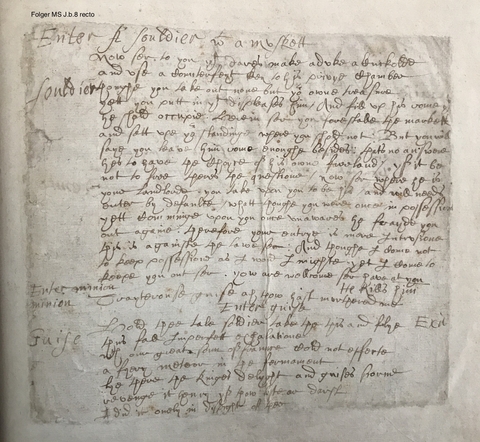
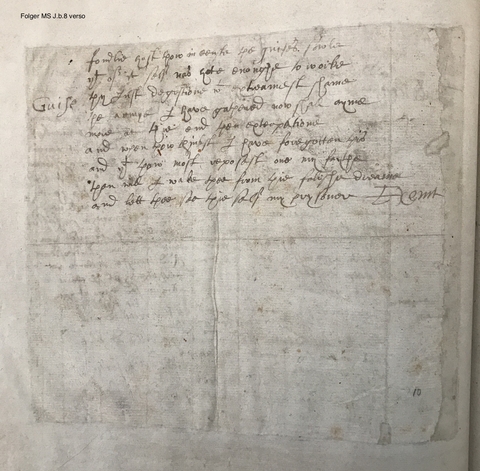
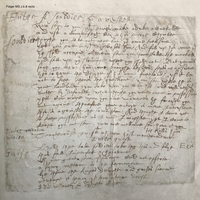
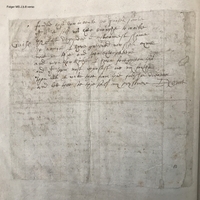
Folger Shakespeare Library MS J.b.8 is a single leaf with a handwritten fragment from Massacre at Paris. The only surviving printed version of the play is short, and often considered to be memorial reconstruction (see Maguire); the manuscript, while written not by Marlowe (CELM), offers a longer version of one scene of the play. Laurie Maguire points to this manuscript as part of the proof that the printed version of The Massacre at Paris ([1596]) is a memorial reconstruction, that is, it was pieced together by actors from memory (Shakespearean Suspect Texts, 281; “Marlovian texts,” 44-47).
The Massacre at Paris is a play about the 1572 Saint Bartholomew’s Day Massacre, where Catholics, led by the Duke of Guise, murder Huguenot (Protestant) nobles, notably the house of Navarre. The manuscript fragment offers an extended version of the scene where a soldier shoots and kills Mugeroun, a minor character from King Henry III of Navarre’s court and a Protestant who was sleeping with Guise’s wife. The added lines in the fragment expand two speeches: the soldier’s lines chastising Mugeroun for cuckolding Guise; and Guise’s final soliloquy crowing over Mugeroun’s death and outlining his (ultimately unsuccessful) plans to take Henry prisoner. See Leah Marcus, Fredson Bowers, or H. J. Oliver for a transcription of the manuscript.
Martin Wiggins and Catherine Richardson note that The Massacre at Paris was likely first performed (with the title The Tragedy at Guise) in January 1593 by Lord Strange’s Men at the Rose. The manuscript fragment from likely also dates to the 1590s (Beal).
This manuscript once belonged to John Payne Collier (1789-1883), a well-known scholar who is, today, infamous for his forgeries, including forging historical and literary documents. Given Collier’s ownership, some scholars questioned the fragment’s authenticity (see Freeman and Ing Freeman, 132-33 and 1075-76; Beal, MrC23, and Downs).
It is now generally accepted that the leaf is from the late sixteenth century but not written by Marlowe himself. R. Carter Hailey suggests that this manuscript fragment was “was probably an insertion produced subsequent to the author’s initial draft,” which was possibly created for a revival of the play (35). Wiggins and Richardson point to evidence that The Massacre at Paris was performed again in London in 1601 and 1602.
The origins of The Massacre at Paris leaf remain unknown. This manuscript’s existence hints at other, unknown versions of Marlowe’s final play.
Laura Estill, St Francis Xavier University
Works Cited
Beal, Peter. “Christopher Marlowe: Introduction." A Catalogue of English Literary Manuscripts (CELM).
Bowers, Fredson, editor. The Massacre at Paris. In The Complete Works of Christopher Marlowe. Vol. 1, 355-416.
Downs, Gerald E. “The Collier Leaf.” 3 part listserv post. Shaksper: The Global Electronic Shakespeare Conference. 4 August 2006.
Freeman, Arthur, and Janet Ing Freeman. John Payne Collier: Scholarship and Forgery in the Nineteenth Century. Yale University Press, 2004.
Hailey, R. Carter. “The Publication Date of Marlowe’s Massacre at Paris, with a Note on the Collier Leaf.” Marlowe Studies, no. 1, 2011, pp. 25–40.
Maguire, Laurie E. “Marlovian Texts and Authorship.” The Cambridge Companion to Christopher Marlowe, edited by Patrick Cheney, Cambridge University Press, 2004, pp. 41–54.
---. Shakespearean Suspect Texts: The “Bad” Quartos and Their Contexts. Cambridge University Press, 1996. Cambridge University Press.
Marcus, Leah S. “The Massacre at Paris.” Christopher Marlowe at 450, edited by Sara Munson Deats and Robert A. Logan. Routledge, 2015, pp. 145-62.
Oliver, H. J., editor. Dido Queen of Carthage and The Massacre at Paris. By Christopher Marlowe. Methuen, 1968.
Wiggins, Martin, with Catherine Richardson. “947: The Massacre at Paris.” British Drama 1533–1642: A Catalogue, Vol. 3: 1590–1597. Oxford University Press, 2013.
- Title
- The Massacre at Paris Fragment
- Rights
- Creative Commons Zero
- Location
- Folger Shakespeare Library
- Item sets
- Manuscripts