Marlowe Memorial
Item
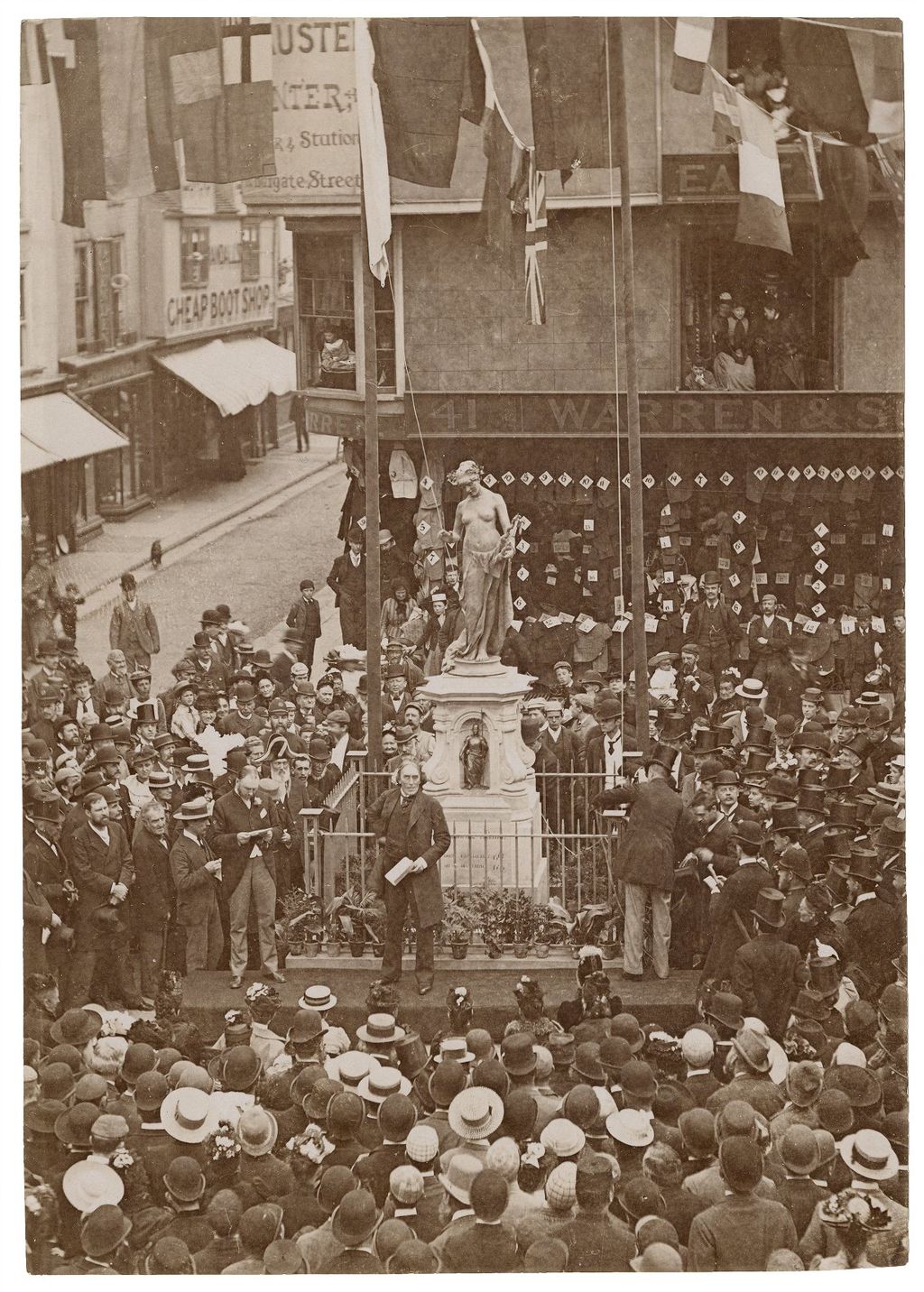
As he unveiled the memorial to Christopher Marlowe on December 16th, 1891, the renowned actor-manager Henry Irving proclaimed that Marlowe “employed with a master hand the greatest instrument of our literature” (quoted in MacLure, 185), that is, blank verse.
The Muse of Poetry stands, bare-breasted, holding holding a lyre with a seashell base. Today, the plinth features four Marlovian figures nested in alcoves, but when it was first unveiled there was only one figure: Irving himself as Tamburlaine. Later, the small statues of Faustus, Edward II, and Barabas were added. At the time Onslow Ford sculpted the Muse, there were no known likenesses of Marlowe, so “the memorial took an allegorical form” (Rogers 165). Having the Muse of Poetry commemorate Marlowe offers a material counterpart to George Peele’s 1593 remembrance: “Marley, the muses darling for thy verse” (qtd. in Sawyer 97).
In order to create the memorial, James Ernest Baker led a committee that raised funds. As Baker wrote in an appeal published in The Academy in 1890, “the committee wish to erect an artistic monument to commemorate Marlowe’s genius, because he was the first of Englishmen hopefully perceived the laten capabilities of the decasyllabic metre, and, by his strong but delicate manipulation of it, showed that powerful, sensuous, and exquisite music that could be evoked from it; and because, … he is one of the most original of the Majestic series of the English poets, and the creator of English drama in each of its principal branches” (206). The Marlowe Memorial Committee was founded by the Elizabethan society. The committee comprised scholars such as Sir Sidney Lee, Horace Howard Furness, A. B. Grosart; writers including Alfred Lord Tennyson, Robert Browning, James Russell Lowell, and A. C. Swinburne; and the Lord Chief Justice of England, John Coleridge (Rogers 161).
Frederick Rogers, one of the members of the committee members, recalls facing criticism for the Marlowe Memorial project because Marlowe “had the reputation of being an atheist” (161). In his speech at the statue’s unveiling, Rogers emphasized Marlowe’s ties to Canterbury: “Son of one of your city’s handicraftsmen … Educated at your King’s school yonder, brought up under the shadow of your stately cathedral” (164-65).
Edward Onslow Ford (1852-1901) sculpted the Muse of Poetry as a memorial to Marlowe. Onslow Ford was a well-known Victorian sculptor whose work was at the forefront of the New Sculpture movement (Stocker). One of Onslow Ford’s “defining works” is his sculpture of Irving as Hamlet and his best-known piece is his commemoration of Percy Bysse Shelley, which Hilary Fraser points out references the Muse of Poetry.
After being moved to different locations in Canterbury, the Muse of Poetry now stands in front of the Marlowe Theatre, where it was unveiled on the four hundredth anniversary of his death by Sir Ian McKellen in 1993 (McKellen). Locals call her “Kitty” (Sawyer 247).
In the Saturday Review description of the Marlowe Memorial’s unveiling, one observer repurposed Ben Jonson’s words about Shakespeare: “A good poet’s made, as well as born” (qtd. in MacLure, 186). The Marlowe Memorial does exactly this: it participates in making Marlowe and his ongoing reputation.
Laura Estill, St. Francis Xavier University
Works Cited
Baker, James Ernest. “The Marlowe Memorial.” The Academy 22 March 1890, vol. 37, no. 933, p. 206.
Fraser, Hilary. “Grief Encounter: The Language of Mourning in Fin-de-siècle Sculpture.” Word & Image vol. 34, no. 1 (2018): 40-54.
MacLure, Millar, ed. “The Marlowe Commemoration: Henry Irving and Others” (from The Saturday Review, 19 September 1891), Christopher Marlowe: The Critical Heritage. Routledge, 1979. 184-86.
McKellen, Ian. “Passionate Spy Who Rivalled Shakespeare.” Sunday Express 23 May 1992.
Rogers, Frederick. Labour, Life and Literature: Some Memories of Sixty Years. Smith, Elder, 1913.
Sawyer, Robert. Marlowe & Shakespeare: The Critical Rivalry. Palgrave Macmillan, 2017.
Stocker, Mark. “Ford, (Edward) Onslow (1852–1901), sculptor.” Oxford Dictionary of National Biography. October 04, 2007. Oxford University Press.
- Title
- Marlowe Memorial
- Creator
- Edward Onslow Ford
- Rights
- Public Domain
- Format
- Statue
- Location
- Canterbury, UK
- Date
- Erected 1891
- Item sets
- Objects